

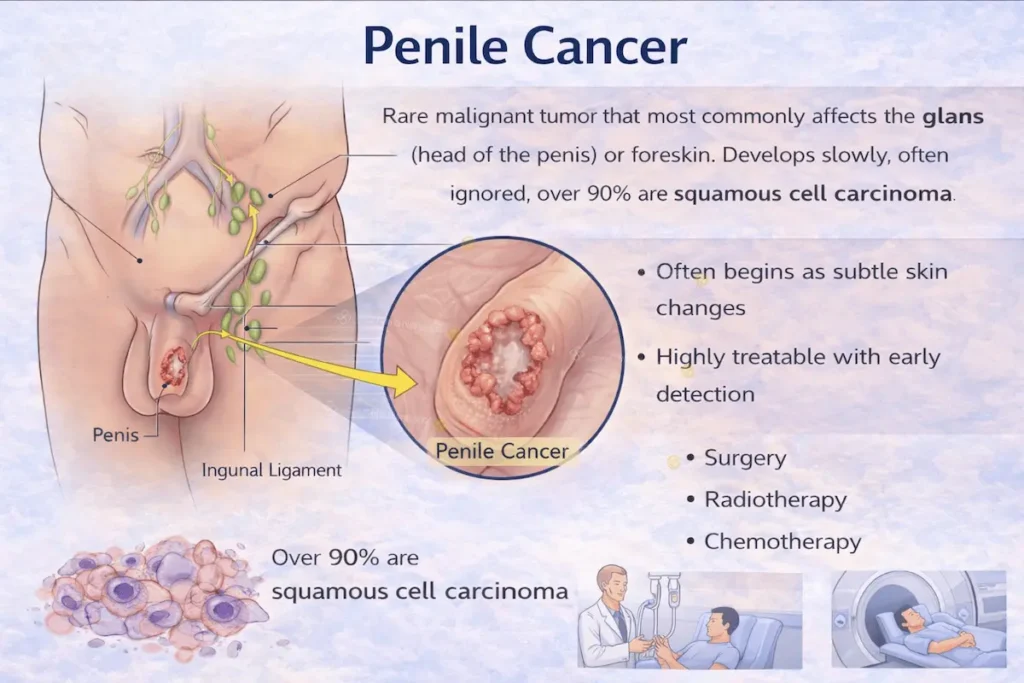
Penile cancer is a rare type of cancer that develops in the tissues or skin of the penis. In most cases, it begins on the glans (the head of the penis) or under the foreskin. Because the early signs may look similar to common skin irritation or infection, many patients delay seeking medical attention. However, when detected early, penile cancer is often highly treatable.
At We Care Asia China, we emphasize the importance of early diagnosis, personalized treatment planning, and preserving quality of life whenever possible.
Types of Penile Cancer
Several forms of penile cancer can occur, including:
Squamous Cell Carcinoma (SCC)
This is the most common type, accounting for the majority of penile cancer cases. It starts in the thin, flat cells covering the surface of the penis. Some subtypes grow slowly, while others may spread more aggressively.
Melanoma
A rare but aggressive cancer that develops from pigment-producing skin cells.
Basal Cell Carcinoma
An uncommon and usually slow-growing cancer affecting the skin of the penis.
Sarcoma
A very rare cancer that begins in connective or soft tissues.
Common Symptoms
Early symptoms are often painless and easy to overlook. Signs may include:
- A sore, ulcer, or lump on the penis
- Thickened or discolored skin
- Redness, white patches, or unusual growths
- Bleeding or foul-smelling discharge
- Difficulty retracting the foreskin
- Swelling in the groin lymph nodes
- Pain in more advanced stages
Any abnormal penile lesion that does not heal within a few weeks should be examined by a medical professional.
Risk Factors
Certain factors may increase the likelihood of developing penile cancer, such as:
- Human papillomavirus (HPV) infection
- Poor genital hygiene
- Smoking
- Phimosis (tight foreskin)
- Chronic inflammation or infection
- Multiple sexual partners
- Increasing age, especially over 50 years old
Studies show that HPV infection is strongly associated with many penile cancer cases.
Stages of Penile Cancer
Doctors commonly use the TNM staging system to determine how far the cancer has spread.
- Stage 0: Cancer cells remain only on the surface layer of the skin.
- Stage I: The tumor has invaded nearby tissue but has not spread to lymph nodes.
- Stage II: Cancer has spread deeper into penile structures.
- Stage III: Cancer has spread to nearby groin lymph nodes.
- Stage IV: The disease has spread to distant organs or pelvic lymph nodes.
Understanding the stage helps doctors choose the most suitable treatment plan.
Diagnosis
To confirm penile cancer, doctors may recommend:
- Physical examination
- Biopsy (the most important diagnostic test)
- Ultrasound or MRI scans
- CT scan or PET scan
- Lymph node evaluation
- HPV testing in selected cases
Early diagnosis significantly improves treatment outcomes and may help preserve normal urinary and sexual function.
Treatment Options
Treatment depends on the cancer type, stage, and overall health of the patient.
Surgery
Surgery may be performed to remove cancerous tissue while preserving as much normal tissue as possible.
Radiation Therapy
Radiation uses high-energy rays to destroy cancer cells and may be used alone or alongside other treatments.
Chemotherapy
Chemotherapy may help control advanced or metastatic penile cancer.
Minimally Invasive Therapies
At We Care Asia China, minimally invasive approaches may be considered for selected patients to reduce trauma and support faster recovery.
Supportive and Integrative Care
Comprehensive care may include supportive therapies aimed at improving patient comfort, immune support, and overall quality of life.
Can Penile Cancer Be Prevented?
Although not all cases can be prevented, several measures may help reduce risk:
- Maintaining good genital hygiene
- Avoiding smoking
- HPV vaccination
- Seeking treatment for persistent infections or foreskin problems
- Regular medical evaluation for unusual penile changes
Why Early Detection Matters
Many patients feel embarrassed discussing symptoms related to penile health, which can delay diagnosis. Seeking medical advice early can make treatment more effective and may allow better preservation of physical function and appearance.
At We Care Asia China, patients receive individualized cancer care supported by experienced medical professionals and modern treatment technologies.